


HUMBER VTS
Associated British Ports, London, UK
Associated British Ports (ABP) is the UK’s largest ports group, owning and operating 21 ports around the country, and handling some 25 per cent of all seaborne trade in and out of Britain. In addition to handling shoreside operations, ABP is also the designated Statutory Harbour Authority in a number of locations, including for the nation’s busiest foreign-trading estuary, the Humber. The Humber contains no fewer than four of ABP’s busiest ports – Hull, Goole, Grimsby and Immingham – and shipping to these ports and others is controlled by Vessel Traffic Services (VTS) Humber.
Humber Estuary Services
VTS Humber forms part of Humber Estuary Services (HES), and is tasked with monitoring and regulating navigation, both on the Humber itself, and on those parts of the Rivers Ouse and Trent that fall within the jurisdiction of ABP’s Harbour Master, Humber, Captain Phil Cowing. As well as controlling navigation, VTS also acts to gather and distribute information to all river users, and to serve as a liaison between the requirements of the various dockmasters, wharf operators and shipping agents along the estuary.
The area controlled by VTS reaches 12 miles out to sea, covers the whole of the Humber Estuary, and stretches up the Ouse and the Trent as far as Goole and Keadby respectively. The main VTS station is located at Spurn Point, at the very tip of a sandbar that extends three miles from the northern edge of the Humber Estuary. 17 VTS staff work here in shifts, with three operators being on duty at any given time. Its isolated location is ideal for controlling navigation both within the estuary and out to sea, and the only downside is that the roadway that connects the VTS centre to the mainland is sometimes rendered impassable in severe weather. But as Captain Ian Spikings, VTS Manager, explains, “Spurn Point can be accessed and re-supplied by boat, so if the land route is cut off, it doesn’t tend to present too many problems. Staff rotate through the station for about a week at a time, so living quarters and food are already provided.” The other main hub for VTS is the Data Centre in the Port of Hull.
This acts as the main link between VTS and the pilots of HES, and co-ordinates the delivery and recovery of pilots from vessels. Inbound ships are required to contact VTS two-and-a-half hours before arriving at Spurn Point: this early warning allows HES staff ample time to travel to Hull, board their pilot boat and travel to meet the incoming vessel as it reaches Spurn Point. As they journey up-river, they are tracked by radar scanners located at Spurn Point, Stone Creek (on the north bank, opposite the Port of Immingham), and the King George Dock at the Port of Hull. Radar is not the only means of monitoring the Humber shipping, however, as all commercial vessels displacing more than 300 tonnes are (by law) fitted with Automatic Identification Systems (AIS).

These transponder-style devices transmit VHF signals that contain an array of relevant information, including a vessel’s name, call sign, position, draught depth and destination. These details are detected and decoded by VTS computers, and displayed on workstations around the estuary. Staff at Spurn Point retain control over movements, but a remote display can be also be seen on a full set of consoles within the Data Centre. In the event of any failure of the systems at Spurn Point, operational control can be switched to the Marine Response Centre at Immingham, which houses a full set of back-up equipment.
VTS is officially recognised by the Maritime and Coastguard Agency (MCA), and incorporates two related, but separate, roles. Downstream of the Humber Bridge, VTS is a traffic organisation service, whereas upstream of the bridge, the requirement by the MCA is to provide an information service only. Throughout the area covered by VTS, ‘River Broadcasts’ are released every two hours, containing information on weather, sea states, tidal readings and other important navigational details. Upstream from the Humber Bridge, a number of AIS receivers are in place, including at the Port of Goole, but there are no radar scanners. This is in part due to the changed role that VTS has in this part of the Humber, Ouse and Trent, but also because the narrowing estuary makes radar imaging more prone to ‘scatter’ returned from land based objects rather than ships.

The microwave links that are used to pass high volumes of information between the centres at Spurn Point, Hull and Immingham had been in place since 1997, and so were due for replacement. “Ten years may not seem a very long lifespan for mechanical equipment, but for digital or electronic systems, it was important that VTS kept up with the technological advances in this field. The new Raft microwave links provide us with the reliable wireless data transfer capability that we need”. Other less conspicuous, but equally important upgrades included the air-conditioning units for the computer mainframes, and enhanced backup power supplies for emergency use.
All systems had been successfully upgraded and installed by July 2007. A brief shakedown period allowed staff to put their training into practice, and, with three staff on duty, to adapt to dividing the VTS area of responsibility into three parts rather than two. Captain Spikings concludes: “This array of upgrades enables VTS to function more efficiently at a time when traffic on the Humber is getting busier and busier. Last year, we processed over 40,000 vessel movements, and we’re confident that we can cope with projected growth over the coming years.
VTS upgrade
From late 2006, almost the entire system operated by VTS was given a comprehensive upgrade. “One of the problems with carrying out such extensive work,” says Captain Spikings, “was that VTS, rather like an air traffic control system, is in operation 24 hours a day, and cannot be taken offline even for a short period of time. To cope with this, the work was completed in phases, and temporary ‘bypass’ mechanisms were used to cover equipment and software that was in the process of being replaced.
At the control tower at Spurn Point, for instance, the operators worked from another floor while the main room was refurbished and re-equipped.” Much of the work was carried out for ABP by Kongsberg Norcontrol IT (a subsidiary of Kongsberg Defence & Aerospace), including the fitting of the latest Voc 5060 digital display consoles at Spurn Point, Hull, Goole and Immingham.
The Spurn Point control room was also designed to house three consoles and operators instead of two, as had previously been the case. The Voc 5060 units have touch-sensitive flat screens, and have high levels of commonality with those used by the MCA. Before this new equipment could be installed operationally, however, it was necessary to train VTS staff in the use of the new consoles.
While this was taking place in late 2006, other upgrades were also being implemented. New Xetron VHF/AIS receivers were added along the river, and new radar transmitter/ receivers supplied by Terma were installed at Hull and Spurn Point. The existing radar scanners themselves, however, were of sufficiently high standard to not need replacing – “almost of military-grade”, says Captain Spikings.


Upgrade complete for VTS Humber

The Humber Estuary drains one fifth of the area of England

2021 saw in excess of 34,000 ship movements on the Estuary

15,000 Acts of Pilotage were carried out in 2021

Humber Estuary Services are responsible for over 145 square miles of Estuary

There are 127 floating marks on the Humber, all maintained by ABP

There are 127 floating marks on the Humber, all maintained by ABP


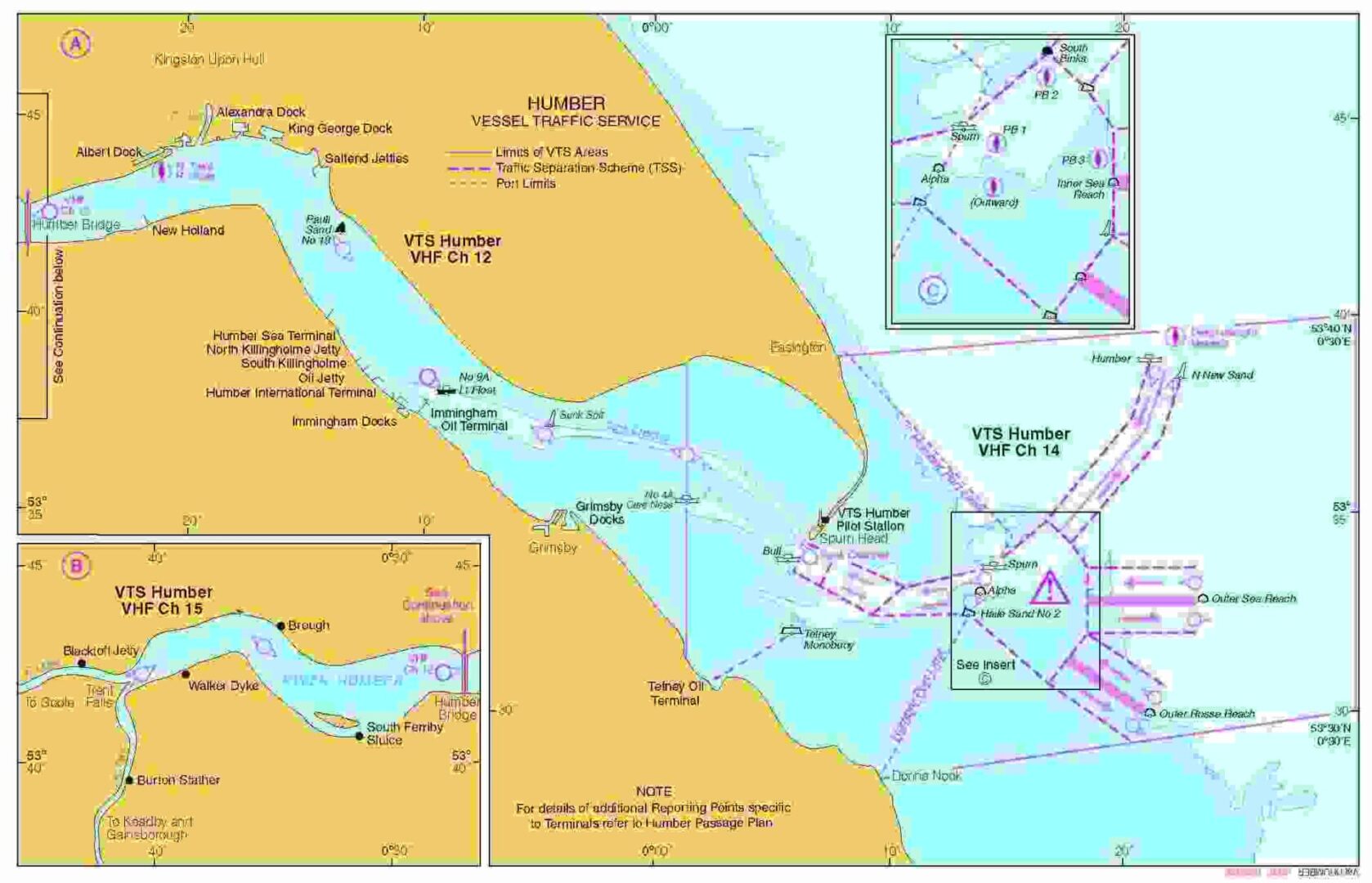
Vessel Traffic Services (VTS) Humber, which is located at the Humber Marine Control Centre (HMCC) in Grimsby, operates a 24-hour service for all river users. Its major function is to monitor and regulate navigation of those parts of the Humber Estuary and Rivers Ouse and Trent within the jurisdiction of the Harbour Master, Humber. The system is compulsory for all sea-going vessels and craft when entering the Humber VTS area. The Service provides AIS coverage throughout the VTS area and radar tracking within the area bounded by the Humber Bridge and the seaward limits of the VTS area.
The Service provides information regarding: the arrival, berthing, anchoring and departure of vessels, navigational aids, navigation hazards, visibility and the safety of vessel traffic.
Tidal information at Spurn Point, Grimsby, Immingham, Hull, Humber Bridge, South Ferriby, Brough, West Walker Dyke, Blacktoft, Goole, Burton Stather, Flixborough and Keadby is available on request.
- A straight line drawn from Easington Church in the County of East Riding of Yorkshire (Latitude 53° 39’. 02 North, Longitude 0° 06’. 90 East) in a direction 086° (T) to a position 53° 40’. 00 North, 0° 30’. 00 East.Then a straight line in a direction 180° (T), to a position 53° 30’. 00 North, Longitude 0° 30’. 00 East
- Then a straight line in a direction 262° (T), to the site of the former Donna Nook Beacon in the County of North Lincolnshire (Latitude 53° 28’. 40 North: Longitude 0° 09’. 23 East).
- The River Ouse up to Skelton Railway Bridge and
- The River Trent to Keadby Bridge
VHF Channel 14 is the main operational working Channel for the
Humber Approaches through to the meridian of longitude passing
through the No.4A Clee Ness Light Float.
VHF Channel 12 is the main operational channel for the Middle
Humber upriver of the meridian of longitude which passes through
the No. 4A Clee Ness Light Float to the Humber Bridge.
VHF Channel 15 is the main operational channel for the Upper
Humber upriver of the Humber Bridge and includes those areas of
the River Ouse and River
VTS Humber
Humber Marine Control Centre
Wharncliffe Road
Grimsby
DN31 3QL
Tel: 01482-212191
Fax: 01482-218773
Website: www.Humber.com
Communications
A continuous watch is maintained on VHF
A continuous watch is maintained on VHF Ch. 16, 15, 14 and 12.
Vessels communicating with VTS Humber and other vessels within the Humber Harbour Area must use Standard Marine
Vocabulary phrases.
Vessels arriving for destinations within the Humber must give VTS Humber two and a half hours initial notice of arrival at the Papa Bravo One Pilot Station on VHF Channel 14 and then set a listening watch on VHF Channels 14 and 16.
Mariners are required to report to VTS, HUMBER on VHF when
passing the following reporting points:
Outer Binks Light Buoy, Outer Sea Reach Light Buoy or
Outer Rosse Reach Light Buoy.
When Pilot embarks / disembarks.
Spurn Light Float / No. 2 Haile Sand Light Buoy.
When anchoring.
On passing No. 4A Clee Ness Light Float call on the appropriate VHF channel for the area you are entering.
Sunk Spit Light Buoy, (inwards only)
No. 9A Light Float. (outwards only)
No. 19 Paull Sand Light Buoy.
On passing Humber Bridge call on the appropriate VHF channel for the area you are entering.
Brough.
When entering or departing the River Trent or River Ouse at Trent Falls.
Passing Skelton Railway Bridge.
Passing Keadby Railway Bridge.
When all fast or departing any lock or any berth.
All vessels when either singled up and ready to let go from a river berth or prior to leaving a lock when gates are open will ask VTS Humber for clearance to sail.
Having been given clearance to sail, if any delay is then envisaged, the vessel should inform VTS and seek further clearance when the cause of the delay is resolved.
When clearance to sail has been granted by VTS Humber, the vessel should proceed without delay, providing the Master is satisfied that it is safe to do so.
Further to this, Masters and Pilots are required to report when they are securely moored at their final berth of destination within the Humber Harbour Area.
VTS Humber "VEE TEE ESS HUMBER"
24 hours service.
Radar surveillance
Radars (3cm Xband). Located at Spurn Point, Stone Creek (opposite Immingham) and Hull.
VTS Humber provides a Traffic Organisational Service bounded by the seaward limits and the Humber Bridge.
And VTS Humber provides an Information Service bounded by the inland limits in the rivers Trent and Ouse and the Humber Bridge.
The Master of a vessel which
has been involved in a collision with any vessel, navigation mark, bridge, shore facility or other object
has been sunk, grounded or is in such a condition as to affect its safe navigation
causes an obstruction to a fairway
is aware of any pollution to the environment.
shall report the occurrence to VTS HUMBER. VTS Humber will respond to the situation and alert the appropriate authorities in accordance with the VTS Humber Operations and Procedures Manual.
A general broadcast giving weather reports, tidal information and navigational warnings is made by Vessel Traffic Services, Humber on Channel 12, 14 and 15 every 2 hours commencing 0103 hours, prior notification being given on Channel 16.
London VTS covers an area of some 600 square miles of waterway spanning 95 miles from Teddington to the North Sea.
The London VTS team ensures safety of life at sea, safe and efficient navigation, and protects the marine environment, adjacent shore areas, work sites and offshore installations from the possible adverse effects of maritime traffic.